
LSG — semi-automatic weigh filling machine for jerrycans and small containers
Put the container on the platform. Line it up under the nozzle. Press start. The machine tares, doses to the net weight and stops.
It is the smallest machine we make, and for a plant filling a few hundred containers a day it is usually the only one worth buying. Nothing moves except the product.
Plug & Fill series · Semi-automatic · Containers 1–30 L

Is this the machine you need?
Yes, if you fill jerrycans, bottles or similar containers below thirty litres, one at a time, and an operator loads and unloads them by hand.
No, if you fill drums — the LSB does those — or IBCs (totes), which is the LSC. And if you need hundreds of containers an hour with capping and sealing in line, that is the EL2-E.
Every AiCROV machine handles virtually any industrial liquid — viscous, sticky, foaming, flammable, corrosive. What changes with the product is the nozzle, the materials in contact with it and how the dose is controlled. Not the model.
What decides the model is the container format, the throughput you need, and how much of the handling you want the machine to do. That is why our range is not organized by industry. A detergent plant and a lubricants plant filling the same drum at the same rate buy the same machine.
How it works
1. Filling recipe and net weight are selected on the operator panel.
2. Filling height is adjusted to the container format, without tools.
3. The empty container is placed on the weighing platform.
4. The container opening is aligned with the nozzle.
5. On start, the system tares automatically and fills to the net weight.
6. The full container is removed and the next one goes on.
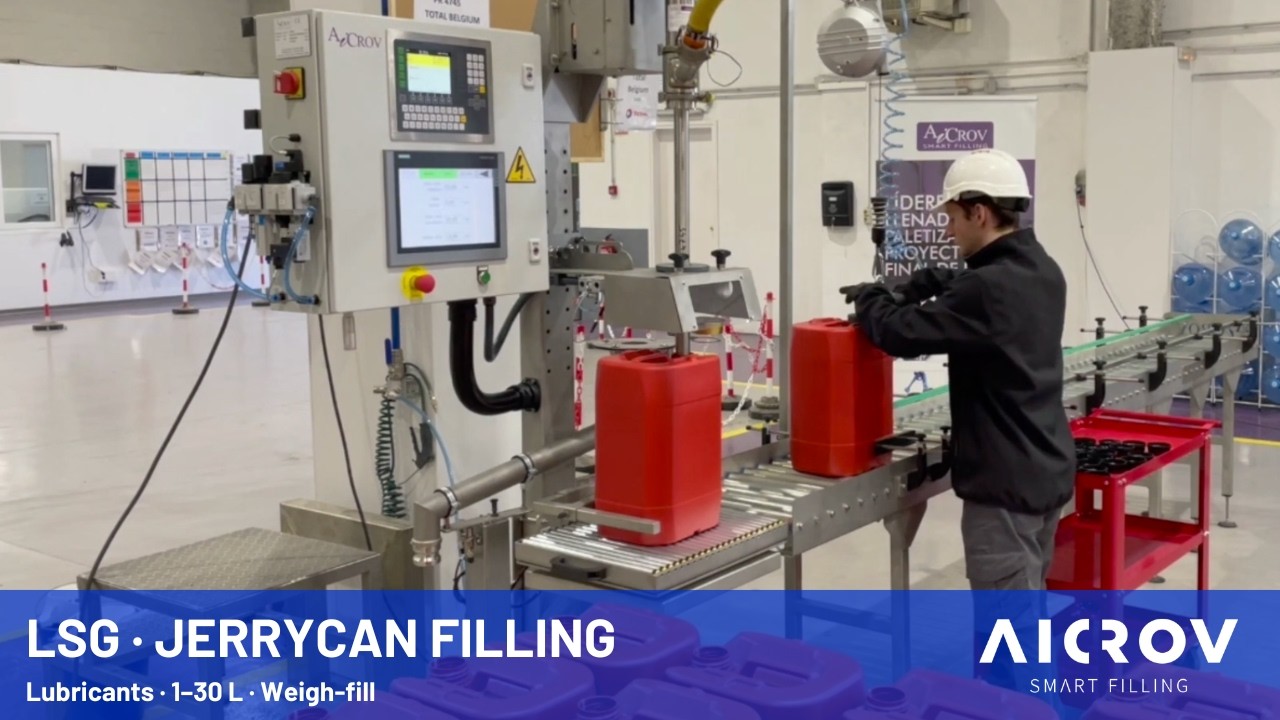
LSG Semi-Automatic Filler — Jerrycans 1–30 L | Lubricants, TotalEnergies | AiCROV
An LSG filling lubricant jerrycans from 1 to 30 litres, one at a time, by weight.
More videos of this machine
Other installations and configurations, filmed in our workshop and at customer sites.

LSG Semi-Automatic Filling Machine — Jerrycans & Drums up to 60 L | Fragrance | AiCROV

AiCROV – LSG – Automatic Jerrycan Filling Machine
Filling modes: two assemblies
Two filling assemblies are available, and the choice is made when the machine is ordered: the assembly is a physical part of the machine, not a setting. Both are made of sandblasted AISI 304 stainless steel; the nozzle is AISI 316L as standard, with other materials available for demanding products.
Under bunghole filling
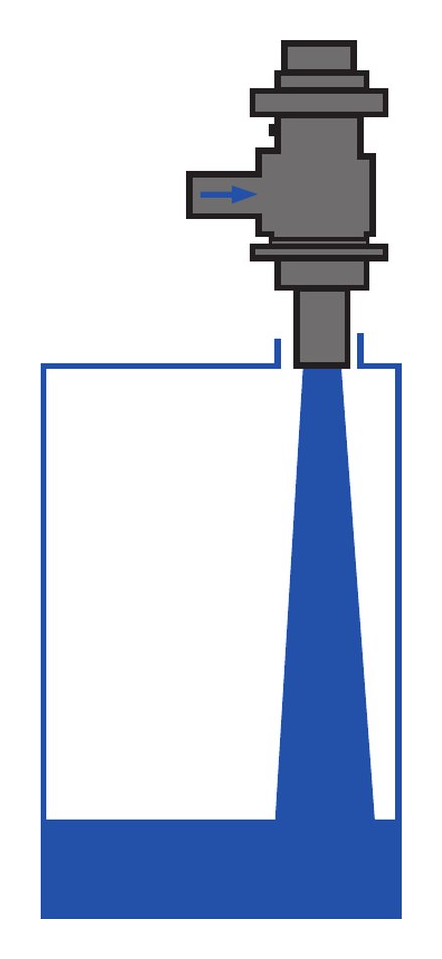
Normally used for products that do not foam and are neither flammable nor explosive, including dense and viscous products. The nozzle descends until it is just inside the container and fills from that position. This assembly fills under the bunghole only.
Immersion filling

Normally used for foaming products, and for flammable or explosive products. The nozzle descends to the bottom of the container, and the filling recipe chooses one of three ways of filling:
- Rising with the product: the nozzle opens at the bottom and rises as the container fills. The control calculates the product height inside the container and keeps the nozzle at that level, stopping at the top of the container, without leaving it, until the fill is complete.
- From the bottom: the nozzle stays at its lowest position for the whole fill. For extremely foaming products.
- Under bunghole: the nozzle enters just past the bunghole and fills from there, as the under-bunghole assembly does.
If your range includes foaming or flammable products, or may include them later, choose the immersion assembly: it covers every way of filling.
Machine architecture
A self-supporting structure carries the column on which the filling head, with its dosing group and actuation, is mounted. The nozzle stays in a fixed position — it is the container that moves to it. The weighing terminal is integrated into the control system, so weight governs the cycle directly rather than through an external indicator. The control cabinet and the pneumatic group complete the assembly.
The weighing platform is flat and accepts free rollers to ease handling. For repetitive formats there is a quick centring device, manually adjustable to each container type, which fixes the position of the opening beneath the nozzle and removes the need to align by eye on every cycle. It is an accessory, not part of the standard supply.
Inert gas filling (optional)
Any AiCROV machine can be supplied to fill under an inert atmosphere. It is fitted as an accessory, and it touches the nozzle, the control cabinet and the recipe.
How it is built. The nozzle carries a small passage through which the gas flows. A dedicated solenoid valve in the main control cabinet drives that flow, so the gas is part of the filling cycle rather than something an operator does alongside it.
When the gas flows is a recipe parameter, not a fixed setting. You choose to inert before the nozzle opens, during filling, after the target weight is reached, or any combination of the three — and you set how many seconds each phase lasts. Different products need different answers, and the machine stores one per product.
Why a small amount of gas is enough. Nitrogen is heavier than air. A short burst into the bottom of an empty container leaves a layer of nitrogen sitting there, and filling then begins inside that atmosphere rather than in air. As the product level rises, the nitrogen is pushed up ahead of it and stays between the liquid and the container opening. A little more at the end, before the container is capped, and the product has never touched air.
It is not always nitrogen. The gas is chosen for the product; nitrogen is simply the most common.
Inerting by overpressure is the other route: capping assemblies that pressurize the inside of the container to a few millibars immediately before the cap goes on.
And the case that is not about product quality at all. Filling a flammable product into a metal container can generate a spark as the liquid starts to flow. Displace the oxygen first and there is nothing to ignite. On some installations that is the whole reason the inerting is there.
The nozzle is interchangeable. It can be replaced by a different model or diameter without modifying the structure or the filling head, which means the machine can be adapted to a different product or a different container years after it was bought. How nozzles are cleaned →
AiCROVFill®
Weighing a container while you fill it is not difficult. Getting the last hundred grams right, every time, on a product that foams, settles or clings to the lance, is the whole job. AiCROVFill® is the filling control AiCROV has developed and refined since its first filling machine in 2009, installation after installation.
A software ecosystem, not a single function. AiCROVFill® is the whole of AiCROV’s filling software, built around one aim: to fill as accurately and as fast as the product allows — efficient in time, effective in the result — and always safely.
Misalignment control. If the nozzle meets resistance as it descends into the container, it returns to its upper position and waits for the operator to realign it. It does not force the container.
Final weight control and top-up. Once the nominal net weight is reached, the nozzle closes. For a set interval afterwards the system keeps watching the settled weight, and if it has fallen below the nominal value it reopens and completes the dose — as many times as needed. This is the difference between a container that reads correct at the moment of closing and one that reads correct on the customer’s scale.
Compensation for the submerged lance. In immersion filling the nozzle can stay below the product surface — because the operator has set it to fill under the level to keep a foaming product quiet, or because, near the top of a full container, it cannot rise any further without leaving the opening. A submerged lance displaces its own volume of product, and the scale reads that displacement as weight. Close the nozzle at the nominal value, draw the lance out, and the container is suddenly tens or hundreds of grams short — a fill that looked perfect now fails the tolerance. AiCROVFill® knows where the lance is: its position is controlled, so the volume it occupies inside the product is known at every moment. The control calculates the weight that volume accounts for and doses exactly that much more before closing, so the net weight is right after the lance comes out, not only while it is still in.
Automatic compensation of the product still falling after the valve closes. When the valve closes, some product is still on its way into the container. How much depends on the machine, and on conditions outside it: supply pressure, flow rate, product temperature and viscosity. If the recipe carries a fixed value for that product, AiCROVFill® uses it. If that value is set to zero, the machine learns it: container after container it measures the result and moves the cut-off point by itself, so the batch settles on the nominal weight and stays there as conditions drift.
Recipe-based operation. Filling parameters are stored per product and per container format. Changing reference is a selection on the panel, not a readjustment of the machine.
Built from parts you can buy yourself
This machine is built with industrial components from globally distributed brands — control, pneumatics, sensors and weighing elements — with no proprietary electronics or firmware anywhere in the control chain.
This matters on the day something fails. You source the spare part yourself, in your own market, at market price. Your maintenance staff work on platforms they already know. You do not wait for a shipment from Tarragona to replace a component that is on a shelf twenty minutes from your plant.
It is a deliberate design decision, and we think a machine that holds your plant hostage is not a machine you should buy.
Safety and compliance
The machine is designed and manufactured in Europe, to European machinery safety legislation, and carries the CE marking. That is our starting point for every market we ship to. Outside the EU, most markets mirror that legislation through a transposition or an equivalent framework of essential health and safety requirements, so AiCROV starts from the same design and the same risk assessment everywhere, and adapts the marking, the declaration and the documentation to the regime of the country of installation.
The design follows the harmonised framework customary in the sector: risk assessment and risk reduction to EN ISO 12100, safety-related parts of control systems to EN ISO 13849-1, electrical equipment to EN 60204-1, emergency stop to EN ISO 13850.
The risk assessment is carried out on the configuration actually supplied, not on a generic model, and the resulting measures are built into the mechanical design, the electrical design and the control software.
- Emergency stop — cuts electrical power and pneumatic pressure to the actuators simultaneously. Reset is manual and deliberate.
- Passive nozzle lock — without pneumatic pressure the nozzle cannot open. Loss of air or power stops the machine with the nozzle shut, not with product running.
- Safe behaviour on failure — no residual nozzle movement, no product flow.
Every AiCROV machine can be supplied in an explosion proof version. Where the machine is going into an area with a risk of explosive atmosphere, that protection is engineered as a specific part of the project, under the certification scheme that applies in the country of installation — ATEX in Europe, IECEx in many other markets, NEC in the United States. Explosion proof versions are designed for Zone 1 or Zone 2 hazardous areas, or the equivalent Class I, Division 1 or 2 under NEC, depending on the project.
This is not a variant we assemble occasionally. Most of the explosion proof machines AiCROV has installed are in plants that also run standard machines from us — the same customer, two versions, depending on which room the machine stands in.
Explosion proof filling machines →
Connection parameters — voltage, frequency, neutral and earthing arrangement, electrical and compressed air connection types — and the operator panel language are defined with you during order engineering, in accordance with the regulations and the usual practice of the country of installation. The starting point is always the CE-compliant design; the local requirements are built in from the start of the order, not retrofitted afterwards.
Technical specifications
| Type | Semi-automatic, weigh (gravimetric) filling |
| Series | Plug & Fill |
| Containers | Jerrycans, bottles and equivalent, 1 to 30 litres |
| Throughput | 150 containers/hour (25 L) |
| Filling accuracy | ±0.1% of the nominal fill (to be confirmed for each case) |
| Weight scale resolution | ± 5 g |
| Inert gas filling | Available as an accessory |
| Filling assembly | Under bunghole, or immersion (the immersion assembly also fills under bunghole or from the bottom, selected by recipe) |
| Height adjustment | 550 mm, servo |
| Power | 240 V, 50–60 Hz, 0.5 kW |
| Air pressure | 6 bar (other pressures on request) |
| Working temperature | −10 °C to +45 °C |
| Product temperature | 0 °C to +130 °C |
| Product connection | 1½” male camlock |
| Weight | 300 kg |
| Explosion proof version | Available |
Frequently Asked Questions
What size containers does the LSG fill?
From 1 to 30 litres — jerrycans, bottles and equivalent formats, one at a time on the weighing platform.
How accurate is it?
The weighing platform resolves to ±5 grams. Accuracy is held after closing, not just at the moment of closing: AiCROVFill® re-checks the settled weight and tops up if the product has settled below the nominal value.
Can it fill foaming products?
Yes, with the immersion assembly. The nozzle follows the product level inside the container, or stays at the bottom for highly foaming products, which is what keeps foam down. The way of filling is chosen in the recipe.
Do I need to modify my plant?
No. Power, compressed air and product supply. That is what Plug & Fill means.
Can it fill flammable products?
Yes, in an explosion proof version engineered for the certification scheme of the country of installation. Flammable products are normally filled with the immersion assembly, which keeps the nozzle below the product level, and electrostatic grounding control is available as an option.
What is the difference between the LSG and the EL2-E?
Both fill containers up to 30 litres. The LSG fills one container at a time with an operator; the EL2-E is an automatic in-line machine with several stations and much higher output.
Not sure this is the right machine?
Tell us what you fill, into what container, and how many per hour. We will tell you which model fits — and we will tell you when none of ours does.
Related projects
Real installations of our filling machines in different industries.

Two LSG fillers joined by a roller conveyor for spirits in jerrycans, run by one operator — distillery, United Kingdom
A distillery in the UK needed to fill flammable spirits into jerrycans, several products completely separately, and to get more output without adding operators.

SP2 and LSG packaging plant for water-treatment chemicals — jerrycans, drums and IBCs, Tashia, Spain
Tashia, a manufacturer and packager of water-treatment chemicals, was setting up a new packaging plant and needed to fill jerrycans, drums and IBCs.

SP1 and LSG for Lubricants — Drums, IBCs and Jerrycans for TotalEnergies Belgium
TotalEnergies Belgium needed to fill lubricants into every container size, from small jerrycans to IBCs, with legal-for-trade weighing and few operators.

Explosion proof LSG for flammable liquids in jerrycans and open-head pails from 1 to 30 L — Spain
A chemical producer in Spain needed to fill a flammable liquid into jerrycans and open-head pails of many sizes, in a hazardous area.

Tell us about your product and containers
We will contact you