
Filling technology — how an AiCROV filler touches the product
Every AiCROV machine handles virtually any industrial liquid — viscous, sticky, foaming, flammable, corrosive. The model is decided by the container format, the throughput you need and how much of the handling you want the machine to do. How the machine touches your product is decided by something else: the filling technology. Every AiCROV filler shares it, from the smallest semi-automatic machine to a robotic line — the filling assembly, the nozzle, the control software, the way the filler works with your product supply and, when the product needs it, inert gas.
Smart Filling: the AiCROVFill® filling algorithm
AiCROVFill® is the whole of AiCROV’s filling software, built around one aim: to fill as accurately and as fast as the product allows — efficient in time, effective in the result — and always safely. It follows the Smart Filling concept: the filling process adapts to the product, the container and the environment, and the balance between filling time and accuracy is adjustable for each recipe.
The last kilograms: coarse/fine or proportional filling
Most of a fill is the easy part: the filler runs at full flow. The skill is in the last kilograms, where speed and accuracy pull in opposite directions.
Conventional coarse/fine filling. The flow has three states: open coarse, open fine and closed. The filler runs at full flow until the net weight passes a cut-off point set in the recipe, then drops to a fixed fine flow until it reaches the target, and closes.
Proportional (PID) filling. The flow can be set anywhere from 0 to 100%. The coarse phase is the same — 100% is full flow, exactly as in coarse/fine filling. The difference is in the fine phase: instead of a fixed fine flow, AiCROV’s PID control reduces the flow continuously as the weight approaches the set point, and reaches zero exactly at the target. No time is lost at a slow, fixed fine flow, and the fill does not overshoot.
These charts are a demonstration, with flow rates chosen to make the difference visible. In a real plant, how a fill behaves depends on the product and on the whole fluid system: the pressure and flow at which product arrives, how the pump is fed, how far away it is, the piping between them. That is fluid engineering, and every AiCROV filler is set up for the plant it goes into.
The filler is only half of the system: avoiding water hammer
Close a nozzle abruptly on a supply line that is not expecting it, and the moving column of liquid stops all at once. For a moment, until the plant’s supply system can relieve it, the pressure in the pipe rises sharply. That is surge pressure, or water hammer. It stresses hoses, seals and pumps, it causes splashing at the nozzle, and it can be dangerous.
Many plants live with it. The pump delivers product continuously, and pressure relief valves act once the overpressure is already there: they limit it, but they do not prevent it. The only way to prevent it is to match the flow the filler needs with the flow the plant supplies, moment by moment.
That is why a filling machine is much more than automating the movement, the opening and the closing of a nozzle. It has to work in step with your product supply. AiCROV connects the filler to your plant through digital signals or industrial communication, so that the supply and the filler ask for the same thing at the same time. The result is a smooth fill — no overpressure, no splashing — with high accuracy in a short time. Safety, efficiency and effectiveness: what everyone wants, and where experience makes the difference.
Where the flow is controlled
Coarse/fine and proportional filling do not have to happen in the nozzle. Depending on the product and the plant, the AiCROV filler can:
- switch the nozzle between open coarse, open fine and closed, with the fine flow set mechanically;
- drive a proportional actuator on the nozzle, setting from the recipe how far it opens — this suits plants that fill products of different viscosities and densities on the same machine;
- control the supply pump directly, with a frequency inverter and its electrical protections fitted in the machine’s control cabinet or in an additional cabinet;
- send the plant the flow it needs, as a value from 0 to 100%, so your own control regulates your pumps and valves;
- regulate a proportional valve on the product supply, at the inlet of the hose that feeds the nozzle;
- regulate a recirculation valve on the product line or at the pump.
Which one is right is decided with you during engineering, from the product, the supply and the plant. If you prefer a single supplier, AiCROV can also supply the pump, the product hoses and the valves, turnkey with the filler. The aim is always the same: the filler and the supply working as one system.
Connected to your plant: control room, MES and traceability
AiCROV fillers are built as standard on Siemens or Allen-Bradley controls, and connect to the plant over Ethernet — usually PROFINET, EtherNet/IP or Modbus TCP, and OPC UA when the plant needs it. If your plant uses another protocol, we adapt to it.
What the filler and the plant exchange. From the plant to the filler: permission to fill, product available, and the filling recipe — container type, target weight, coarse/fine cut-off point, product density and the rest of the recipe parameters, which are many and depend on each project. From the filler to the plant: running, manual or automatic mode, filling, the weight being filled, alarms, and counters.
Recipes from SAP, MES or the control room. The full filling recipe can be sent to the machine from SAP, your MES or the control room. Another option we use: the operator scans the barcode or QR code on the work order, the filler asks SAP or the MES for the recipe, and the system sends it. On the operator panel there are normally two access levels — operator and supervisor — so the operator only selects, and only the supervisor can change a recipe. Multinational chemical producers run their AiCROV fillers this way.
A record of every container. When a container is finished, the filler can report it: container number, gross weight on the scale, tare, net weight filled, recipe, filling time and batch. Depending on what your plant needs:
- the simplest option, an Excel file saved to a USB memory stick in the operator panel;
- the recommended option, the record sent to your control room, SAP or MES at the end of each container, so your system stores it before the next one is filled;
- an industrial PC connected to the machine that builds the files itself;
- a SCADA system, for example with Siemens WinCC, that stores all the data.
Audit trail. For bulk pharma and fine chemicals, where it is a must, and for food, where it is widely used, the control can be supplied in an auditable version: every change is recorded, with an audit trail.
Control and safety functions
- Automatic tare. Every container is tared before filling, so what the machine controls is the net weight of product.
- Misalignment control. If the nozzle meets resistance as it descends into the container, it returns to its upper position instead of forcing the container. On semi-automatic machines it waits for the operator to realign it; on automatic ones it stops the sequence and alerts the operator.
- Container position control. On machines that measure the container, the working height is adjusted by motor to the height detected on each container, so the nozzle always enters at the correct level.
- Automatic compensation of the product still falling after the valve closes. When the valve closes, some product is still on its way into the container, and how much depends on supply pressure, flow rate, temperature and viscosity. If the recipe carries a fixed value, AiCROVFill® uses it. If it is set to zero, the machine learns it container after container and moves the cut-off point by itself.
- Compensation for the submerged lance. In immersion filling the lance can stay below the product surface. It displaces its own volume, and the scale reads that as weight. AiCROVFill® knows where the lance is, calculates the weight that volume accounts for and fills exactly that much more, so the net weight is right after the lance comes out, not only while it is still in.
- Final weight control and top-up. After closing, the system keeps watching the settled weight for a set interval. If it has fallen below the nominal value, it reopens and completes the fill, as many times as needed. The container reads correct on the customer’s scale, not only at the moment of closing.
- Independent weighing per station. On in-line machines each filling station controls its own weight, so splitting the fill between stations never costs accuracy on the individual container.
- Recipe-based operation. Filling parameters are stored per product and per container format. Changing reference is a selection on the panel, not a readjustment of the machine.
Filling accuracy equal to the scale division: 20 g on a container scale, 0.1 kg on a drum scale and 0.5 kg on a pallet scale as standard, down to 5 g, 0.05 kg and 0.2 kg with higher-class load cells. Confirmed for each application. When small containers are filled on a pallet, that accuracy comes from an additional scale for the container rather than from the pallet platform.
Two filling assemblies: under the bunghole and immersion
The filling assembly is physical, and it is chosen when the machine is bought.
Under the bunghole
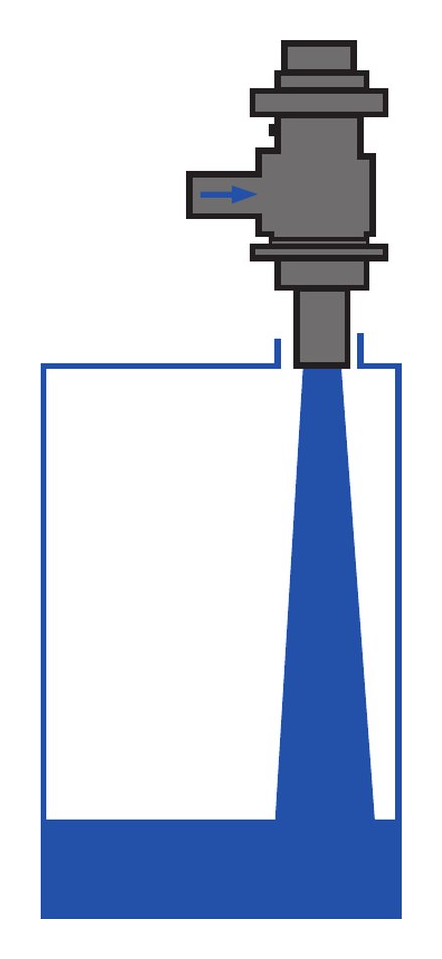
The nozzle enters just past the bunghole and fills from there. Normally used for products that do not foam, are not flammable or explosive, and for dense or viscous products. This assembly fills under the bunghole only.
Immersion

Normally used for foaming, flammable or explosive products. With this assembly the recipe chooses how to fill: under the bunghole; from the bottom of the container, for extremely foaming products; or rising with the product, with the control calculating the product level and keeping the nozzle at that height up to the top of the container without leaving the product.
A machine with the immersion assembly can also fill under the bunghole. A machine with the under-bunghole assembly cannot fill by immersion.
The Basic series fills under the bunghole only; the immersion assembly is available on the Plug & Fill range and above.
Interchangeable nozzles
The nozzle is interchangeable. It can be replaced by a different model or diameter without modifying the machine, so a filler can be adapted to a different product or a different container years after it was bought. The parts in contact with the product are chosen for it: AISI 316L as standard, and other materials, such as titanium, for products that attack stainless steel.
A safety element in itself. Every AiCROV nozzle has a safety spring that keeps it closed, even when it is not mounted on the machine. That is why many plants keep their nozzles off the machine, hanging on a nozzle rack and permanently connected to their own product hoses. The operator changes one nozzle for another quickly and without tools, in two or three minutes.
Nozzle identification (accessory). When each nozzle stays connected to its own hose, its own line and its own tank, mounting the wrong nozzle means filling the wrong product. With nozzle identification, the machine knows exactly which nozzle is mounted. The recipe states which nozzle the fill needs; if that is not the one mounted, the machine does not fill. Asked to fill from tank 5 with the nozzle of tank 3 mounted, it will not start.
Nozzle cleaning
When you change product, what is left inside the nozzle matters. Flush recovers the product left in the nozzle between batches; CIP cleans the inside, the outside and the seals in a closed circuit, with nothing to dismantle. And AiCROV nozzles are designed to be cleaned.
Inert gas filling (optional)
Any AiCROV filler can fill under an inert atmosphere. The nozzle carries a small passage for the gas, and a dedicated solenoid valve in the control cabinet makes the gas part of the filling cycle. The recipe sets when to inert — before the nozzle opens, during filling, after the target weight is reached, or a combination — and for how many seconds.
It matters most in two cases:
- Flammable products. Displacing the oxygen from the container before filling starts means a spark inside the container has nothing to ignite.
- Products that oxidize. A flow of nitrogen displaces the air, and with it the oxygen, and the product is filled into a nitrogen atmosphere from the first drop, so it does not oxidize in contact with air.
A small amount of gas is enough: the nitrogen flow displaces the air, and with it the oxygen, from the headspace of the container before and during filling. Nitrogen is the most common gas, but the same system works with any other gas chosen for the product.
In depth: more on filling technology
Detailed guides from our engineers on specific parts of the filling process.
Frequently asked questions
What is water hammer in a filling line?
Water hammer, or surge pressure, is the pressure spike that appears in a pipe when a valve or nozzle closes abruptly on a moving column of liquid. Until the supply system can relieve it, the pressure in the line rises sharply for a moment. It stresses hoses, seals and pumps, causes splashing at the nozzle and can be dangerous.
How do you avoid water hammer when filling?
By matching the flow the filler needs with the flow the plant supplies. Pressure relief valves only act once the overpressure is there; they limit it but do not prevent it. AiCROV synchronizes the filler with the product supply — through digital signals or industrial communication — and reduces the flow in a controlled way at the end of each fill, with proportional filling or by controlling the pump or a supply valve.
Can the filling machine control my pump?
Yes, in two ways. AiCROV can fit a frequency inverter, with its electrical protections, in the machine’s control cabinet or in an additional cabinet, and control the pump directly. Or the filler sends your plant the flow it needs, as a value from 0 to 100%, and your control regulates its own pumps and valves. AiCROV can also supply the pump, hoses and valves turnkey with the filler.
Which PLCs and protocols do AiCROV fillers use?
As standard, Siemens or Allen-Bradley controls, connected over Ethernet — usually PROFINET, EtherNet/IP or Modbus TCP, and OPC UA when needed. If your plant uses another protocol, we adapt to it.
How do I synchronize the filling machine with my plant?
Through an industrial connection, the plant tells the filler whether it may fill, whether product is available and which recipe to run, and the filler tells the plant whether it is running, in manual or automatic, filling, how much it is filling and whether it is in alarm. What is exchanged is defined with you during engineering.
Can the filling machine synchronize with the product flow?
Yes. The filler can tell your supply the flow it needs at each phase of the fill, or control the pump or a supply valve itself. Synchronizing both is what gives a smooth fill, without overpressure or splashing.
Can I control the filling machine from the control room?
Yes. The filler can be connected to your control room so it can be monitored and, if your plant requires, started and stopped from there.
Can I send filling recipes from the control room, SAP, MES or my own system?
Yes. The full recipe — container type, target weight, cut-off point, density and the other parameters — can be sent from SAP, your MES or the control room. Or the operator scans the barcode or QR code on the work order, and the filler asks your system for the recipe. With two access levels, operator and supervisor, the operator only selects and only the supervisor can change a recipe.
Can I see from the control room whether the filling machine is working?
Yes. The filler reports whether it is running, in manual or automatic mode, filling or in alarm, the weight it is filling and its counters.
Can I record operations, net weights, tares, recipes, filling times and batches?
Yes. Every finished container can be recorded — container number, gross weight, tare, net weight, recipe, filling time and batch. The record can be saved as an Excel file on a USB stick in the operator panel, sent to your control room, SAP or MES after each container (the recommended option), built by an industrial PC connected to the machine, or stored by a SCADA system such as Siemens WinCC.
Do you offer an audit trail for bulk pharma, fine chemicals and food plants?
Yes. The control can be supplied in an auditable version in which every change is recorded. It is a must in bulk pharma and fine chemicals, and widely used in food.
Can the filling machine check which nozzle is mounted?
Yes, with the nozzle identification accessory. The recipe states which nozzle the fill needs, and if a different nozzle is mounted the machine does not fill. It prevents filling the wrong product in plants where each nozzle stays connected to its own hose, line and tank.
Why fill under nitrogen?
For two reasons. With flammable products, displacing the oxygen before filling means a spark inside the container has nothing to ignite. With products that oxidize, the product is filled into a nitrogen atmosphere and does not come into contact with air. The same system works with other gases.
What is the difference between coarse/fine and proportional filling?
Coarse/fine filling runs at full flow up to a cut-off weight and then at a fixed slow flow until the target. Proportional (PID) filling keeps the same full-flow phase but then reduces the flow continuously, reaching zero exactly at the target. It spends less time at slow flow, so the fill is shorter for the same accuracy.
How accurate is an AiCROV filling machine?
Filling accuracy equal to the scale division: 20 g on a container scale, 0.1 kg on a drum scale and 0.5 kg on a pallet scale as standard, down to 5 g, 0.05 kg and 0.2 kg with higher-class load cells. Confirmed for each application. AiCROVFill® also re-checks the settled weight after closing and tops up if needed.
Can a machine with the under-bunghole assembly fill by immersion?
No. The filling assembly is physical and is chosen when the machine is bought. A machine with the immersion assembly can fill both by immersion and under the bunghole.
Get a quotation
Please fill the form below to get in contact: